


An osTicket alternative for teams that want a commercially packaged Docker deployment
osTicket and TaskBridge are both self-hosted ticketing systems, but they approach the job from different directions. osTicket is free, open-source software with an established PHP and MySQL ecosystem. TaskBridge is a paid, source-available osTicket alternative delivered as one Docker container, with a perpetual licence and optional yearly updates.
This is not a comparison between cloud software and self-hosting. In either case, your organisation operates the application and controls where the ticket database lives. The practical decision is whether you prefer osTicket’s GPL-licensed flexibility and broad feature set or TaskBridge’s focused workflow and packaged deployment model.
osTicket and TaskBridge at a glance
| Consideration | osTicket | TaskBridge |
|---|---|---|
| Deployment | Self-hosted PHP application using a supported web server and MySQL | Self-hosted application delivered as one Docker container |
| Software licence | Free, open source and distributed under the GPL | Paid perpetual, source-available licence for the customer’s own use |
| Agents | No per-agent licence fee for the open-source edition | Unlimited agents and end users under the software licence |
| Product scope | Established feature set including custom forms, queues, filters, SLAs, tasks and a knowledge base | Focused email and portal ticket management, permissions, reporting and audit history |
| Operations | Your organisation manages hosting, backups, security and application upgrades | Your organisation manages hosting, backups, security and deployment |
| Updates | Community releases can be downloaded and applied by the operator | Optional yearly updates provide standard TaskBridge releases during active maintenance |
Do not choose TaskBridge simply to avoid agent fees
The downloadable osTicket edition is free and does not charge a software licence for each agent. TaskBridge also includes unlimited agents, but it has a paid commercial licence. If licence price is the only criterion, the free osTicket edition has the obvious advantage.
TaskBridge is relevant when the organisation values its Docker delivery, focused product scope, commercial release path and source access under a perpetual licence. Those differences must be worth the purchase price and the cost of operating the application. A representative demo is the right way to decide whether they are.
Where osTicket may be the stronger fit
- You require software distributed under an open-source GPL licence.
- You want a free self-hosted help desk and can support its PHP, web-server and MySQL stack.
- You need osTicket features such as custom forms, custom queues, ticket filters, SLA plans, tasks or its built-in knowledge base.
- You want access to osTicket’s established community, documentation, plugins and language packs.
- Your team is already comfortable maintaining and upgrading an osTicket installation.
Where TaskBridge may be the stronger fit
- Your standard application-delivery model is Docker and you want the help desk packaged as one container.
- Your core need is structured email and portal ticketing rather than osTicket’s broader configuration surface.
- You prefer a paid perpetual product with an optional yearly release programme.
- You want source access for internal review and organisation-specific customisation under the TaskBridge licence.
- You need clear agent, manager, administrator and end-user roles with configurable permissions and audit history.
Compare the operational work, not only installation
A successful installation is only the beginning for either product. The operator remains responsible for infrastructure availability, backups, restore testing, monitoring, email delivery, access control, TLS, operating-system security and an upgrade process.
osTicket’s current installation documentation describes a conventional web stack with PHP, MySQL and a supported web server. TaskBridge packages the application as one Docker container. That can fit more naturally into an existing container workflow, but it does not remove operational responsibility. Your team should test backup and recovery procedures before either system handles production tickets.
Compare the workflows your team actually uses
osTicket documents capabilities including custom fields and forms, ticket filters, help topics, custom queues, collision avoidance, SLA plans, tasks, a customer portal and a knowledge base. TaskBridge concentrates on tickets created through email or the application, public replies, internal notes, assignments, priorities, categories, permissions, notifications, dashboards, reports and audit history.
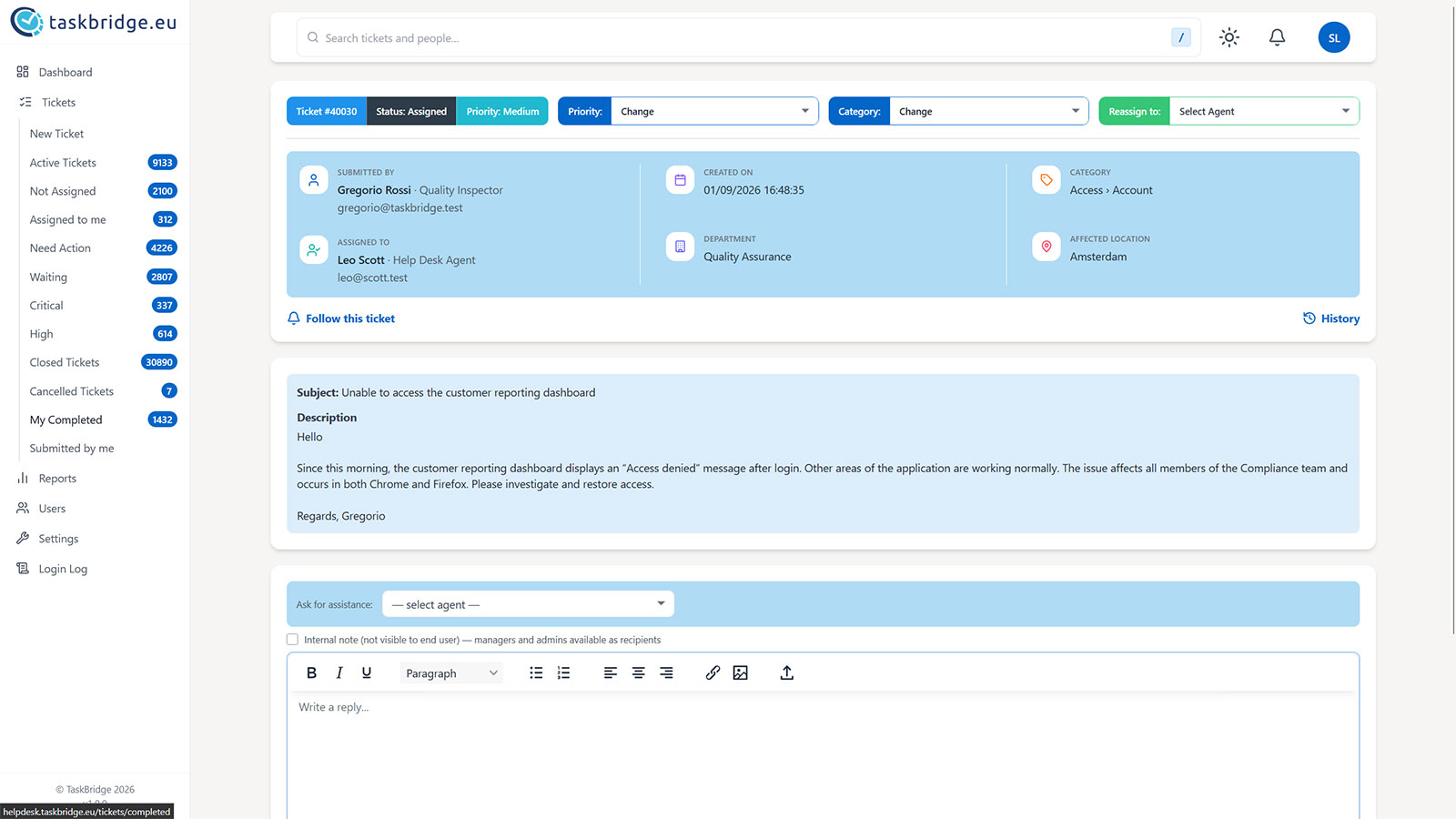
Do not assume that similarly named features behave the same way. Build a short test script from real support work: create a ticket by email, assign it, add an internal note, change its priority, transfer responsibility, reply to the requester, restrict access and retrieve the result in reporting. Run that script in both systems.
Plan migration before choosing a replacement
Replacing an existing osTicket installation requires more than moving open tickets. Inventory users, organisations, complete ticket threads, internal notes, attachments, departments, teams, help topics, custom fields, knowledge-base content and historical reporting. Decide what must remain active in the new system and what can be retained in a read-only archive.
- Document the osTicket features and plugins currently in use.
- Identify the records that must be migrated for legal, operational or customer-service reasons.
- Confirm which data can be exported and how attachments and thread history will be preserved.
- Test a representative data set before committing to a cutover.
- Validate email routing, permissions, notifications, backups and recovery before production use.
Common questions
Is TaskBridge open source like osTicket?
No. osTicket’s downloadable edition is open source under the GPL. TaskBridge is source-available commercial software: the licensed customer receives the source code for its own use and customisation but may not resell or redistribute it.
Is osTicket really free?
The official osTicket FAQ describes the downloadable software as free and open source. Your organisation still pays for infrastructure and the people or services required to install, configure, secure, back up and maintain it. osTicket also offers hosted and professional-service options separately.
Does TaskBridge include future updates?
The perpetual licence lets you continue using the purchased version. Optional yearly updates provide standard releases during active maintenance, and your organisation decides when to test and deploy them. See TaskBridge pricing for the current offer.
Can TaskBridge replace every osTicket feature?
No blanket replacement claim would be responsible. osTicket has features and extensions that TaskBridge may not reproduce. Compare the workflows and integrations your organisation actually depends on, then verify them in a TaskBridge demo.
To test TaskBridge against your existing ticket workflow, request a demo. For deployment, licensing or migration questions, use the Contact page.
osTicket licence, deployment and feature information was checked against its official website and documentation on 1 September 2026. Products and requirements can change; verify current details before making a purchasing decision.